Four Functions, One Wardrobe
Mehendi, haldi, sangeet, reception. Four functions, about six weeks, and one wardrobe. The usual solution is to buy four outfits and wear each of them once.
There is a better answer, and it is arithmetic rather than taste.
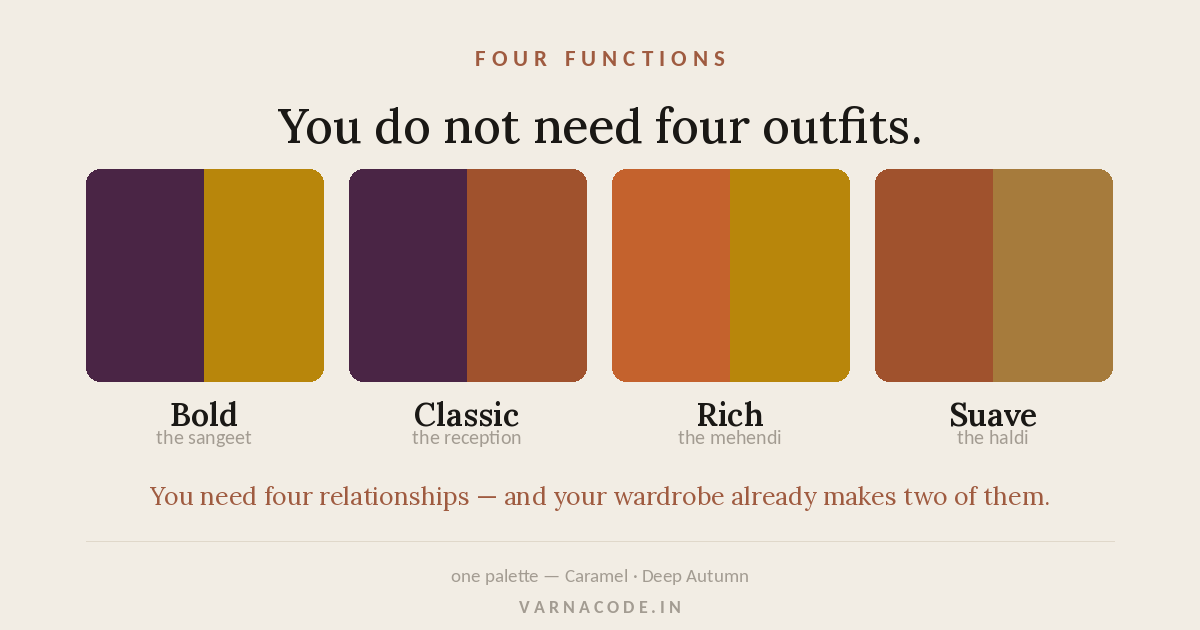
You do not need four outfits. You need four different relationships between colours — and your wardrobe probably already makes two of them.
There are exactly four relationships
Any two colours worn together differ in two ways that matter: how far apart they are in lightness, and how strong the stronger of the two is. Cross those and you get four combinations. Not approximately four — exactly four.
| Name | What it is | Reads as |
|---|---|---|
| Bold | Far apart in depth, strong in colour | Attention. Worn one at a time |
| Classic | Far apart in depth, quiet in colour | A deliberate light–dark relationship |
| Rich | Close in depth, deep in colour | Depth rather than contrast |
| Suave | Close in depth, soft in colour | Tonal dressing |
These four terms, and the rule that they are ranked relative to your own palette rather than against a fixed threshold, are published in the open dataset. The same two colours can be Bold on one person and Rich on another. That is the system working, not a bug.
And there are four functions
Each one wants a different relationship, for reasons that have nothing to do with fashion and everything to do with light and what you are doing.
| Function | Conditions | Wants |
|---|---|---|
| Haldi | Daylight, informal, turmeric will land on you | Suave — and the cheapest thing you own |
| Mehendi | Daylight, seated for hours, loud decor, hands are the subject | Rich or Suave — daylight renders close tones honestly |
| Sangeet | Dark room, warm stage light, hundreds of flash photographs | Bold — flash closes the gap, so start with a wide one |
| Reception | Evening, formal, posed photography | Classic — contrast without shouting |
⚠️ Being straight about this table. The four terms and their definitions are published data. Mapping them onto the four functions is reasoning, not a dataset finding. It follows from the lighting and the setting, and you are welcome to disagree with any row — the argument underneath does not depend on getting all four exactly right.
Why the maths favours one piece over four
Say you own four in-palette tops and three in-palette bottoms.
Buy a fifth top → 5 × 3 = 15 (+3)
Buy a fourth bottom → 4 × 4 = 16 (+4)
That is the usual way of thinking about it, and it is the wrong one. It counts outfits. Occasions are not counted, they are categorised.
If all four of your tops sit at a similar depth, then every one of those twelve outfits is Rich or Suave. Twelve outfits, two categories. You can dress for haldi and mehendi twelve different ways and you cannot dress for the sangeet at all.
🔴 So the question is not “how many outfits does this add”. It is “does this add a relationship I did not have”.
One deep anchor piece — a bottom several shades darker than everything you own — does not add four outfits. It converts a share of the twelve you already had into Bold and Classic pairings. One purchase, two new categories, and the sangeet and the reception both become solvable.
Four outfits bought as outfits will usually produce two categories. One piece bought as a relationship will usually produce four. That is the whole argument, and it is why the order you buy in matters more than the amount you spend.
Which piece you are missing depends on your tone
Some palettes produce contrast naturally. Others have to be given it. The dataset records this directly — each season carries a contrast level:
| Contrast | Seasons | What you are usually missing |
|---|---|---|
| High | Deep Winter — Espresso, Cacao | Rarely an anchor. Your palette makes Bold and Classic on its own. What is usually missing is something quiet for daylight functions |
| Medium | Deep Autumn, Warm Autumn, Warm Spring — Golden, Amber, Caramel, Mocha, Honey | Usually one deep anchor. These palettes are rich in mid-depth colour and short of true darks |
| Low | Soft Autumn, Soft Summer, Cool Summer, Light Spring — Ivory and the softer variants | 🔴 Both. A low-contrast palette can struggle to produce a Bold pairing at all. This is the case where a considered purchase matters most |
Which is the part most advice gets backwards. The people told to “add a pop of colour” are usually the ones who already have contrast. The people who genuinely need a structural piece are the ones being told to keep things soft.
What to do with this on your own
Everything above is enough to work it out yourself, and you should if you enjoy that sort of thing:
- Find your tone — the chart or the free quiz
- Pull out everything in your palette and lay it in order of depth, lightest to darkest
- Look at the spread. If everything sits in the middle third, you have no Bold and no Classic, whatever the colours are
- Check the neutrals against yourself, not against the outfit — a neutral near your face has to clear your face. Fourteen of the twenty-four palettes contain at least one that fails this
- Buy the gap, not the outfit
Or have it done properly
Step 3 is where this gets hard. Judging the depth of your own clothes, against your own skin, from memory, in a wardrobe you look at every day — that is the part people get wrong, and it is the part worth paying for.
The Wardrobe Audit is eleven questions about what you already own. No photograph of you, ever — this site has never asked for a selfie and paying does not change that. You get back a written plan:
- What is already working, and why
- What is quietly fighting your skin tone — usually one or two things you wear often
- Which relationships your wardrobe already makes, and which it cannot
- A buy list in order, so the first thing you buy unlocks the most outfits
The rest of the season
- Haldi colours — when the function’s own colour is not your colour
- Reception colours — why black is the wrong formal answer for the deepest tones
- Sangeet colours by skin tone — why flash changes the answer
- Mehendi colours by skin tone — daylight, decor, and the sleeve problem
- Wedding colours for 2026
- Wedding guest colours for Mocha · for Espresso
- The men’s ethnic wear guide
The four-term taxonomy, the contrast levels and all 192 colour values are in an open dataset under CC BY 4.0, versioned so you can see what changed and when. The method is public. What you are paying for is somebody applying it to your wardrobe rather than to the general case.
Launch price — first twenty
The Wardrobe Audit — ₹2,499
The quiz tells you your colours. This tells you what to do about them. You send photos of the clothes you actually wear — laid flat, in daylight, no people in the frame. I go through them against your palette and send back a written plan: what already works, what is quietly fighting your skin tone, what is missing, and a buy list ordered so the first thing you buy unlocks the most outfits.
Eight to twelve pages. Five working days. Your face is never involved — this site does not read people from photographs, and that does not change because you paid.
Opening to a small number of people first. Leave your email and I will write when a slot is free. No payment now, no obligation.
The quiz and your Wardrobe Plan stay free — always. This is the optional next step, not a paywall. Your email is only used to tell you when a slot opens.