Mehendi Outfit Colours by Skin Tone
Everything that makes a sangeet colour work makes a mehendi colour fail. Daylight is honest, the decor is loud, and for once you are not the only thing being photographed — your hands are.
A sangeet is a dark room and a flash. A mehendi is usually mid-morning to afternoon, often outdoors or under a shamiana, with marigold and green everywhere and you sitting still for two hours while somebody works on your palms.
Three things change, and each of them narrows your palette in a different direction.
1. Daylight is honest, so the subtle end of your palette finally works
At a sangeet, a phone flash lifts your face several shades and closes the gap between your skin and anything worn near it. That is why the evening rule is maximise contrast.
Daylight does none of that. It renders the difference between your skin and a close-toned colour accurately, which means tonal dressing — a colour only a little lighter or deeper than you — reads as deliberate rather than as a mistake.
Mehendi is the one function where the quiet half of your palette is the right half.
2. The decor is a colour, and it is probably one of yours
Marigold and green are the default. If your outfit is the same family, photographs put you in front of a backdrop you are wearing.
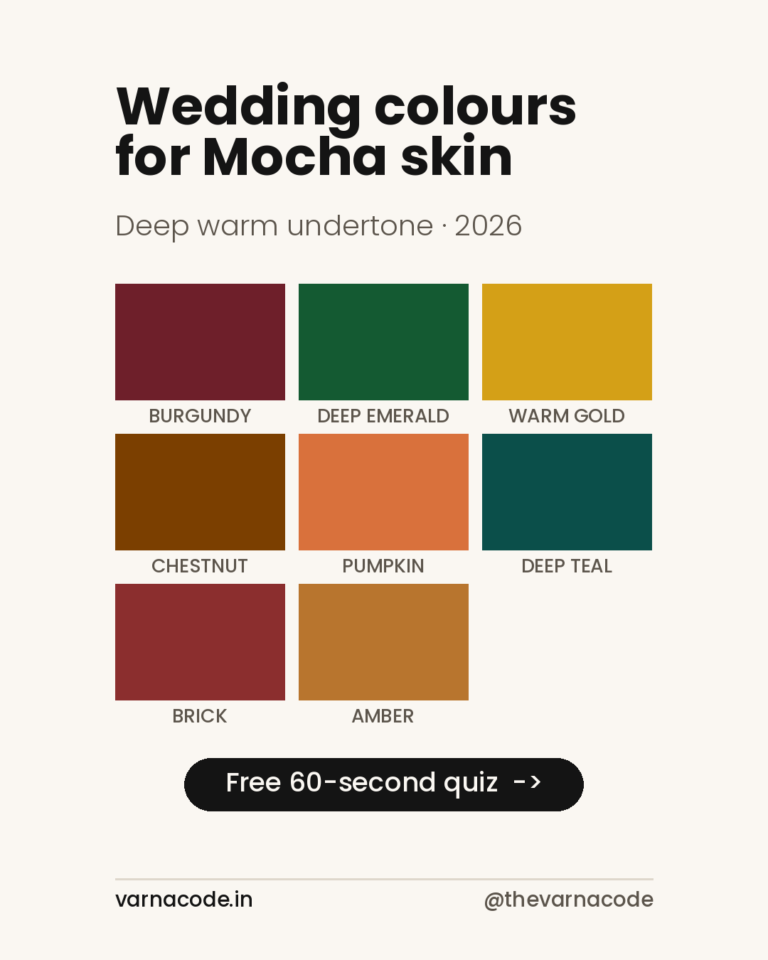
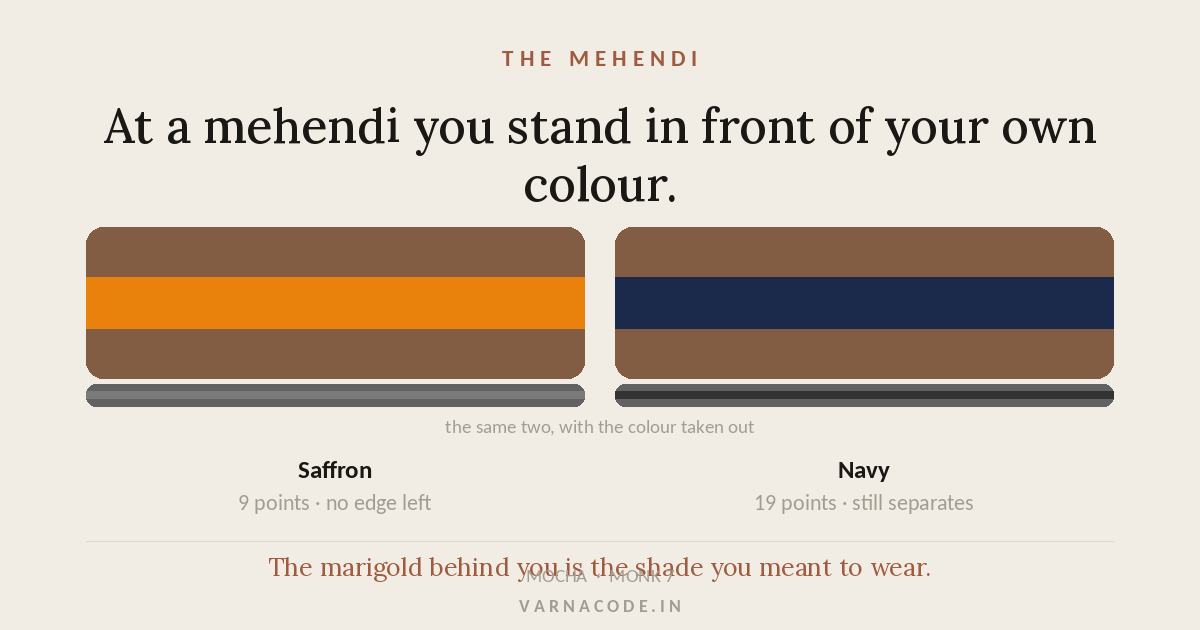
The clearest case is Mocha. Saffron and Gold are the two colours that flatter Mocha skin most at an evening function — warm, saturated, and they glow under stage lighting.
They are also, almost exactly, the colour of the flowers. The same two colours that make Mocha the best-served tone in a dark room make it the hardest to place at a mehendi. Nothing has gone wrong with the palette. The room changed.
3. Your hands are the subject, and sleeves sit right beside them
This is the part almost nobody plans for. Sleeves get pushed to the elbow and stay there for hours. So the sleeve colour ends up directly against forearm skin and drying henna — and henna is a dark red-brown.
Which means rust, sienna, terracotta and deep mustard are henna-adjacent. Worn at the sleeve, they compete with the thing everyone is there to look at.
🔴 And that is the squeeze. Those four colours are precisely what the warm-autumn palettes are built from — Golden, Amber, Caramel and Mocha. The tones best suited to Indian wedding colour in general are the ones most constrained at a mehendi specifically.
The fix is placement, not avoidance. Keep the rusts and terracottas below the elbow line — in the skirt, the lower half of a kurta, the dupatta as it falls. Put teal, navy or aubergine where the sleeve is.
⚠️ What is measured and what is not. The palettes and the lightness gaps below are measured and published openly. “Mehendi decor is marigold and green” and “henna dries red-brown” are observations about Indian weddings, not findings from the dataset. Both are easy to check by looking at any mehendi.
Your mehendi colours, by tone
Two safe picks per tone, chosen to avoid the decor and the henna. The third column is what to keep away from the sleeve — not from the outfit.
| Tone | Wear | Keep off the sleeve |
|---|---|---|
| Ivory Monk 3 · Cool Summer |
Dusty Rose Slate Blue |
Sage — reads as decor |
| Honey Monk 4 · Warm Spring |
Coral Pink Turquoise |
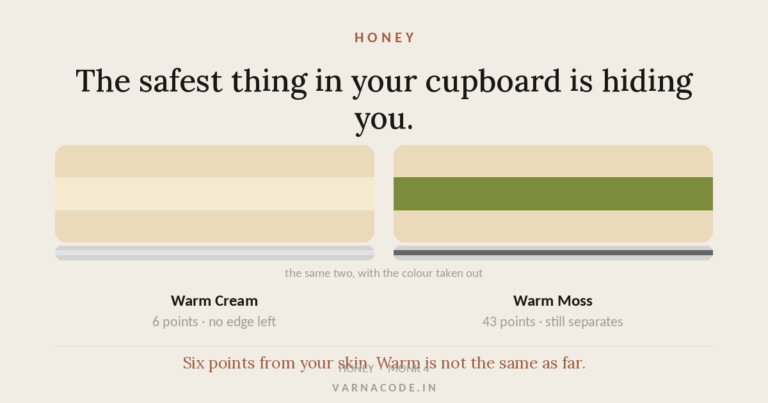
Golden Yellow Warm Moss |
| Golden Monk 5 · Warm Autumn |
Teal Navy |
Mustard Rust — henna-adjacent |
| Amber Monk 5–6 · Warm Autumn |
Aubergine Teal |
Sienna Deep Mustard |
| Caramel Monk 6 · Deep Autumn |
Aubergine Forest |
Spice Orange Sienna |
| Mocha Monk 7 · Deep Autumn |
Navy Forest |
Saffron Gold — both are the decor |
| Espresso Monk 8 · Deep Winter |
Burgundy Sapphire |
Saffron Gold |
| Cacao Monk 9 · Deep Winter |
Amethyst Sapphire |
Marigold — named after the flower |
Notice what the middle column has in common. Teal, navy, aubergine, sapphire, forest — cool and deep, across every tone including the warm ones.
That is not a coincidence. Marigold decor is warm and light; henna is warm and mid-depth. A cool, deep colour is the one thing in most palettes that is far from both.
One caution that applies to every tone
Daylight is unforgiving about neutrals near the face in a way indoor light is not. The gap between a neutral and your own skin does not get rescued by a flash outdoors — it is simply visible.
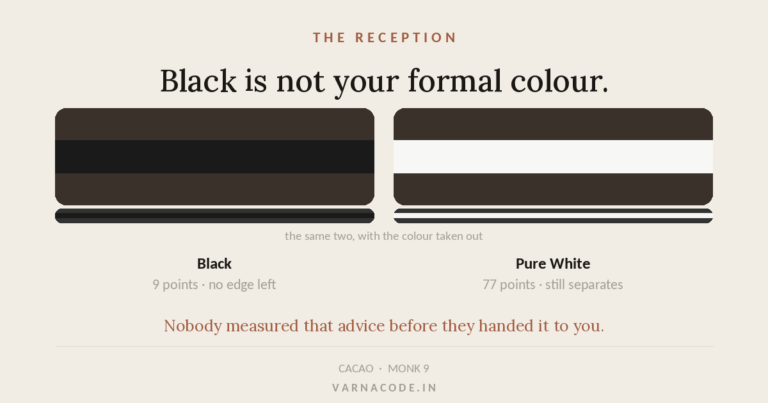
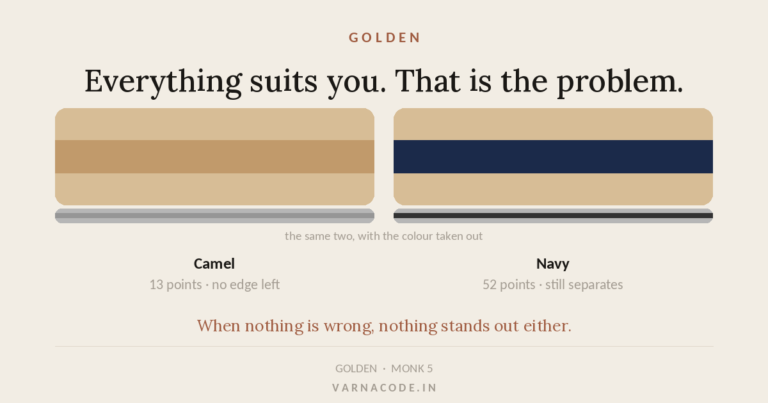
So the neutrals your palette lists as below the waist only are more obviously wrong here than anywhere else. Camel on Amber skin is one point of lightness. Black on Cacao is nine. Charcoal on Cacao is one. In a dark room you might get away with it. At eleven in the morning you will not.
Four functions. One wardrobe. Six weeks.
Mehendi wants cool and deep. Sangeet wants saturated and far from your skin. The reception wants something else again. That is three different answers from one wardrobe — and most people solve it by buying three outfits they each wear once.
The Wardrobe Audit reads what you already own against your palette and returns a written plan: what works, what is quietly fighting your skin tone, and a buy list ordered so the first thing you buy unlocks the most outfits. Eleven questions. No photograph of you, ever.
Read next
- Haldi colours — when the function’s own colour is not your colour
- Reception colours — why black is the wrong formal answer for the deepest tones
- Sangeet colours by skin tone — the opposite problem, and why flash changes the answer
- The skin tone chart — all eight tones with hex values, if you are not sure which is yours
- Wedding colours for 2026
- The men’s ethnic wear guide
Every colour value here comes from an open dataset published under CC BY 4.0 — eight tones, twenty-four palettes, 192 colours, versioned so you can see what changed and when.
Launch price — first twenty
The Wardrobe Audit — ₹2,499
The quiz tells you your colours. This tells you what to do about them. You send photos of the clothes you actually wear — laid flat, in daylight, no people in the frame. I go through them against your palette and send back a written plan: what already works, what is quietly fighting your skin tone, what is missing, and a buy list ordered so the first thing you buy unlocks the most outfits.
Eight to twelve pages. Five working days. Your face is never involved — this site does not read people from photographs, and that does not change because you paid.
Opening to a small number of people first. Leave your email and I will write when a slot is free. No payment now, no obligation.
The quiz and your Wardrobe Plan stay free — always. This is the optional next step, not a paywall. Your email is only used to tell you when a slot opens.